
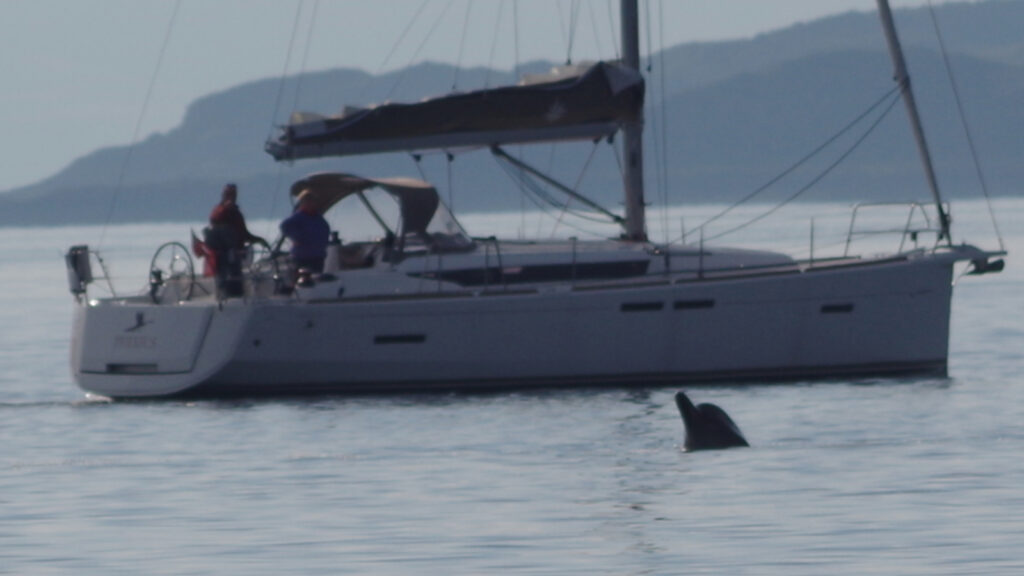
Scientific research raises important questions about the impact of dolphin-watching boats on the animals they seek to observe.
Watching dolphins in the wild can be an unforgettable experience. Dolphin-watching tourism can also bring economic benefits to coastal communities and encourage public interest in marine conservation. However, a growing body of scientific evidence suggests that repeated encounters with boats can have significant negative effects on dolphin behaviour and potentially their long-term welfare.
Less time feeding and resting
Research from New Zealand has repeatedly demonstrated that dolphin-watching activities can interrupt essential behaviours.
Constantine and colleagues (2004) found that bottlenose dolphins spent less time resting as the number of dolphin-watching boats increased. When the number of permitted tourism trips increased from 49 to 70 per week, resting behaviour declined further.
Similarly, Stockin and colleagues (2008) demonstrated that common dolphins exposed to tour boats experienced significant interruptions to feeding and resting. Dolphins also took longer to resume feeding following encounters.
These findings matter because feeding and resting are essential for maintaining an animal’s energy balance. Repeated interruptions may have cumulative consequences, particularly where dolphins encounter multiple vessels throughout the day.
Evidence from Scottish waters
Research conducted in Scotland’s Moray Firth provides particularly compelling evidence.
Using passive acoustic monitoring, Pirotta and colleagues (2015) found that boat presence was associated with a 49% short-term reduction in bottlenose dolphin foraging activity, measured through changes in feeding-buzz detections.
Although this study examined boat traffic generally rather than dolphin-watching vessels specifically, its findings have clear implications for wildlife tourism.
Can repeated disturbance drive dolphins away?
Perhaps the most concerning findings come from Shark Bay, Australia.
Bejder and colleagues (2006) examined long-term dolphin abundance in an area exposed to commercial dolphin-watching activity.
When the number of tourism operators increased from one to two, the researchers recorded an estimated 14.9% decline in dolphin abundance within the tourism area, while no comparable significant decline occurred in the neighbouring control area.
The findings suggest that repeated tourism disturbance may contribute to dolphins abandoning otherwise suitable habitat.
Does responsible boat handling make a difference?
A more recent study by Olaya-Ponzone and colleagues (2025) examined common dolphins in the Bay of Algeciras–Gibraltar.
Researchers found that vessel encounters altered feeding and resting behaviour and increased evasive diving. Disturbance was particularly pronounced when boats failed to follow established approach protocols.
The research reinforces the importance of responsible vessel operation, but also demonstrates that regulated encounters are not necessarily free from disturbance.
The Clyde offers a different opportunity
The Firth of Clyde is in a particularly fortunate position. Its sheltered sea lochs, islands and extensive coastline provide opportunities to observe dolphins directly from the shore, without the need to approach them in a boat.
Unlike wildlife-watching trips that depend on vessels searching for and approaching animals, shore-based watching allows dolphins to continue their natural behaviour without additional disturbance from the observer.
This offers an opportunity for local communities and visitors to enjoy these remarkable animals while placing their welfare first. Shore-based dolphin watching can also support wildlife tourism, environmental education and public engagement in marine conservation without contributing to the cumulative pressures of vessel traffic.
There is something particularly rewarding about watching dolphins from the shore, knowing that the animals are entirely free to choose whether to approach, remain or move away.
In the Clyde, we do not necessarily need to go looking for dolphins in boats. We can allow the dolphins to come to us.
Putting dolphin welfare first
Not every encounter with a boat causes lasting harm, and the effects vary depending on species, location and frequency of encounters. Nevertheless, the scientific evidence consistently identifies feeding and resting as particularly vulnerable to disturbance.
For Scotland’s coastal waters, where dolphins already encounter commercial shipping, recreational vessels and other human activities, the cumulative effects of additional wildlife-watching traffic deserve careful consideration.
Responsible boat-based wildlife watching should minimise repeated approaches, avoid pursuing dolphins and allow animals sufficient space to continue their natural activities.
But where shore-based watching is possible, as it is in the Clyde, it offers a particularly attractive alternative.
The challenge is not simply to bring people closer to dolphins, but to help people appreciate them without adding to the pressures they already face.
Perhaps the best dolphin encounter is one in which the dolphins never know we are there.