
As environmental campaigner Don Staniford faces further legal proceedings brought by salmon producer Bakkafrost Scotland, the dispute raises important questions about corporate power, animal welfare, public access to coastal waters and the future of independent environmental scrutiny.
Who has the right to investigate Scotland’s salmon farms?
Scotland’s coastal waters are a shared natural resource, supporting marine wildlife, fisheries, recreation, tourism and coastal communities. They are also home to a substantial salmon farming industry.
Over recent years, the ability of independent investigators to examine conditions at salmon farms has become the subject of a series of legal disputes involving some of Scotland’s largest aquaculture companies.
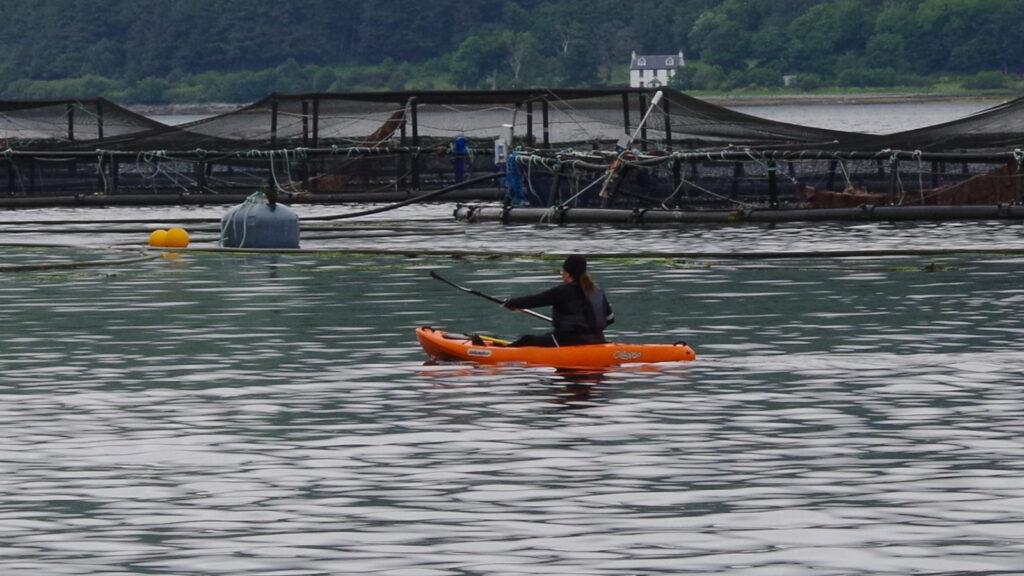
Environmental campaigner Don Staniford has spent years documenting conditions at Scottish salmon farms, often travelling by kayak and using underwater cameras to record fish health, mortality, sea lice infestations and other potential animal welfare concerns.
His investigations have attracted public attention and contributed to a wider debate about the environmental and welfare consequences of intensive salmon farming.
They have also led to legal action involving three major salmon producers: Mowi Scotland, Scottish Sea Farms and Bakkafrost Scotland.
The companies maintain that they are entitled to protect their property, staff, equipment and biosecurity. Staniford and supporters of independent environmental scrutiny argue that the restrictions being sought risk preventing legitimate investigations into matters of public interest.
The underlying question goes beyond one campaigner or one industry:
How can Scotland protect legitimate commercial interests without allowing legal and financial power to discourage independent environmental investigation?
NEXT COURT HEARING
Wednesday 11 November 2026
Dunoon Sheriff Court
Bakkafrost Scotland Ltd v Don Staniford
Case reference: DNN-A29-23
What is a SLAPP?
SLAPP stands for Strategic Lawsuit Against Public Participation.
The term describes abusive legal proceedings used to discourage, restrict or penalise participation in matters of public interest.
Such proceedings may target environmental campaigners, journalists, researchers, whistleblowers or community groups.
The potential consequences extend beyond the immediate litigation. Even where an individual is prepared to defend their actions in court, the possibility of substantial legal expenses can discourage others from undertaking similar investigations.
This is sometimes described as a chilling effect on public participation.
Not every legal action against a campaigner constitutes a SLAPP. Companies and individuals have legitimate rights to protect their property and seek legal remedies where appropriate.
However, the repeated use of litigation by well-resourced organisations against individuals carrying out public-interest investigations raises important questions about proportionality and access to justice.
Civil liberties organisations, including Index on Censorship and representatives of the UK Anti-SLAPP Coalition, have expressed concerns about the Bakkafrost proceedings.
Whether any particular action legally amounts to abusive litigation is a separate matter from those publicly expressed concerns.
Mowi Scotland: the first major legal challenge
In 2021, salmon producer Mowi Scotland began legal proceedings against Don Staniford following his unauthorised visits to company fish farms.
Staniford had approached salmon pens by kayak and, on some occasions, boarded farm walkways to film conditions inside the cages.
Mowi argued that these activities constituted unlawful interference with its property and raised safety and biosecurity concerns.
Staniford maintained that his investigations were intended to document matters of public interest, particularly fish health and animal welfare.
In 2023, Oban Sheriff Court granted Mowi a permanent interdict restricting Staniford’s access to its facilities.
Staniford appealed the ruling.
On 14 March 2024, the Sheriff Appeal Court upheld the central prohibition on entering or interfering with Mowi’s aquaculture structures.
However, the interdict was narrowed following an unopposed request by Mowi’s legal representative. The amendments removed a 15-metre exclusion zone, restrictions concerning drone flights and a provision relating to encouraging others.
The judgment drew a distinction between the public right to navigate coastal waters and any entitlement to board privately owned aquaculture equipment.
It did not establish a general prohibition on navigating near fish farms or publicly criticising their operations.
Staniford subsequently sought a further appeal, but permission was refused in November 2024.
The financial consequences
The proceedings also highlighted the potentially significant costs associated with challenging a major company in court.
In April 2025, Fish Farming Expert reported that Mowi was seeking approximately £83,000 in legal costs relating to its proceedings against Staniford.
Later reporting indicated that the overall costs being pursued were higher.
Whatever view is taken of the original legal dispute, the prospect of legal expenses of this magnitude demonstrates the financial risks faced by individuals involved in prolonged litigation.
Such risks can have consequences extending well beyond a single defendant.
Scottish Sea Farms: further legal restrictions
Scottish Sea Farms subsequently pursued separate proceedings against Staniford, seeking to restrict unauthorised access to its aquaculture facilities.
The company argued that its action was necessary to protect property, operational safety and biosecurity.
Proceedings were paused while Staniford’s appeal against Mowi continued.
In July 2025, Staniford gave a permanent undertaking to Oban Sheriff Court not to enter or interfere with specified Scottish Sea Farms property.
The undertaking imposed further restrictions on his ability to undertake close-range investigations at facilities belonging to another major salmon producer.
Staniford described the outcome as a serious setback for his campaigning activities.
Scottish Sea Farms maintained that its concern was unauthorised entry onto company property rather than preventing lawful criticism or protest.
The distinction is important. Restrictions on entering privately owned structures are not the same as a general prohibition on gathering environmental information or expressing concerns about aquaculture.
Nevertheless, the cumulative effect of proceedings involving multiple companies raises legitimate questions about the practical opportunities available for independent monitoring.
Bakkafrost Scotland: the proceedings at Dunoon Sheriff Court
The latest major legal dispute involves Bakkafrost Scotland, part of the Faroese salmon farming group.
Bakkafrost has pursued an interdict against Staniford through Dunoon Sheriff Court, seeking restrictions relating to its aquaculture facilities and other company property.
The proceedings have attracted particular attention because of proposals that included a 15-metre exclusion distance around specified facilities and restrictions concerning individuals acting with Staniford.
The proposed distance restriction is significant because a comparable provision was removed from the Mowi interdict during the 2024 appeal.
In September 2025, The Guardian reported on the Bakkafrost proceedings and concerns raised by civil liberties organisations about their potential effect on environmental investigations.
Staniford’s legal representatives questioned the justification and proportionality of the restrictions sought.
Bakkafrost’s legal representative argued that the dispute concerned property rights rather than freedom of expression and maintained that the company was not attempting to prevent Staniford from publicly criticising its operations.
These are competing legal positions in an ongoing civil case.
The publicly available case record identifies the proceedings as Bakkafrost Scotland Limited v Don Staniford, DNN-A29-23, at Dunoon Sheriff Court.
A pre-proof hearing appeared in the public listings for 27 October 2026. The next hearing date is Wednesday 11 November 2026. We have provided a sworn disposition for this case that supports Dons position and may be called to provide evidence. For legal reasons we are limited on what we can currently discuss here but will report further in due course.
The court will determine the legal issues before it according to the evidence and applicable law. No conclusion about the merits or ultimate outcome of the ongoing proceedings should be assumed.
The broader debate, however, concerns the rights of independent investigators and the extent to which commercial operators may seek restrictions around activities taking place within Scotland’s coastal environment.
What about the animal welfare concerns?
Amid the arguments concerning interdicts, property rights and legal costs, there is a risk that the underlying issues prompting environmental investigations receive less public attention.
Scottish salmon farming faces recognised challenges associated with disease, parasitic infestations, fish mortality, husbandry and environmental management.
Fish welfare is a legitimate matter of public concern.
The industry is subject to regulatory oversight, including fish health, animal welfare and environmental requirements. Operators also undertake their own monitoring and reporting.
Independent investigations can complement these arrangements by identifying concerns that merit further examination.
Underwater video recordings, photographs, field observations and scientific measurements may all contribute useful information when collected responsibly and assessed within their limitations.
Such evidence does not automatically establish that an offence has occurred. Allegations of unlawful practices require appropriate investigation, reliable supporting evidence and consideration of the relevant legal requirements.
However, potential concerns should not be dismissed solely because they are raised by individuals critical of an industry.
A credible environmental regulatory system should be capable of considering evidence on its merits, independently of the identity or opinions of the person presenting it.
Why independent investigation matters
Many important environmental concerns first emerge through observations made outside official monitoring programmes.
Community groups, independent researchers, recreational divers, fishers, sailors and coastal residents can all contribute valuable information about changes taking place in the marine environment.
Their observations may identify issues requiring more detailed scientific investigation or regulatory attention.
At Clyde Porpoise, our work examines the wider marine ecosystem, including harbour porpoises, underwater sound, marine habitats and the cumulative impacts of human activities in Scotland’s coastal waters.
Independent marine research depends on access to reliable environmental information and the freedom to report findings and raise questions.
It also depends on responsible conduct.
Environmental monitoring should respect the law, navigational safety, legitimate property rights and appropriate biosecurity arrangements.
These responsibilities do not remove the need for transparent regulation and meaningful opportunities for independent scrutiny.
The two principles should be complementary.
Commercial operations should be protected against unlawful interference, while independent environmental monitoring and lawful public-interest reporting should also be protected.
Corporate litigation and the chilling effect
The question of legal costs is particularly important where disputes involve multinational businesses and individual campaigners.
Large commercial organisations generally have access to financial and legal resources far exceeding those available to individuals or small environmental groups.
An individual faced with prolonged litigation may have to consider not only the likelihood of success but also the risk of substantial financial liabilities.
That concern can discourage others from investigating environmental practices, even when their proposed activities would be lawful.
The potential chilling effect is one of the reasons why anti-SLAPP legislation has become an increasingly important issue across Europe and the United Kingdom.
It is possible to recognise legitimate corporate property rights while also questioning whether the scope and financial consequences of legal proceedings are proportionate.
Those questions are central to the wider public-interest debate surrounding the Staniford cases.
Scotland’s proposed anti-SLAPP reforms
The Scottish Government consulted on Strategic Lawsuits Against Public Participation in 2025.
In its subsequent response, the Government agreed that Scottish law should be reformed to address SLAPPs, while acknowledging that further work was necessary before legislation could be introduced.
Supporters of reform have called for safeguards that would help courts identify and dismiss abusive proceedings at an early stage, together with appropriate protection against disproportionate legal costs.
Effective reform must preserve access to justice for legitimate claims while preventing misuse of legal proceedings to suppress public participation.
Environmental investigation is one of the areas where such protections may be particularly relevant.
Small organisations and individual researchers should not face unreasonable obstacles to undertaking lawful activities or communicating evidence about matters affecting the public environment.
A wider responsibility for Scotland’s marine environment
Scotland’s seas are increasingly subject to competing pressures from aquaculture, commercial fishing, marine infrastructure, shipping, recreational activity and other forms of development.
These activities operate within interconnected ecosystems that support marine mammals, fish populations, seabirds and coastal communities.
Protecting those ecosystems requires more than regulatory compliance on paper.
It requires reliable evidence, effective enforcement, independent observation and transparent decision-making.
Companies have a legitimate interest in protecting their operations and employees.
The public also has a legitimate interest in understanding how activities carried out within the marine environment affect wildlife, animal welfare and ecological health.
The legal system must provide fair and proportionate protection for both interests.
The question facing Scotland
The legal proceedings involving Don Staniford have become part of a much wider debate about environmental accountability, corporate litigation and the ability of individuals to challenge powerful commercial interests.
The outcome of the Bakkafrost case is a matter for Dunoon Sheriff Court.
But the broader public-interest issues will remain important regardless of that outcome.
Scotland needs effective animal welfare regulation, transparent environmental monitoring, responsible independent investigation and legal safeguards against genuinely abusive litigation.
These are not competing objectives.
They are essential components of a system in which commercial activity can coexist with environmental responsibility and public accountability.
The health of Scotland’s marine environment depends not only on the laws governing activities at sea, but also on the ability of society to observe, investigate and independently question their consequences.
That is a principle worth protecting.
Sources and further reading
- Scottish Courts and Tribunals Service — Mowi Scotland Ltd v Don Staniford, Sheriff Appeal Court judgment, 14 March 2024
- The Guardian — Bakkafrost accused of blocking investigations, 24 September 2025
- Fish Farming Expert — Scottish Sea Farms undertaking, 18 July 2025
- Fish Farming Expert — Mowi legal costs report, 2 April 2025
- Dunoon Sheriff Court case record — DNN-A29-23
- Scottish Government — SLAPP consultation response
Editorial note: This article addresses publicly reported legal proceedings and wider environmental matters. It does not comment on witness evidence in the ongoing Bakkafrost case or suggest that any company has been found to have committed animal welfare offences or pursued a legally established SLAPP.