
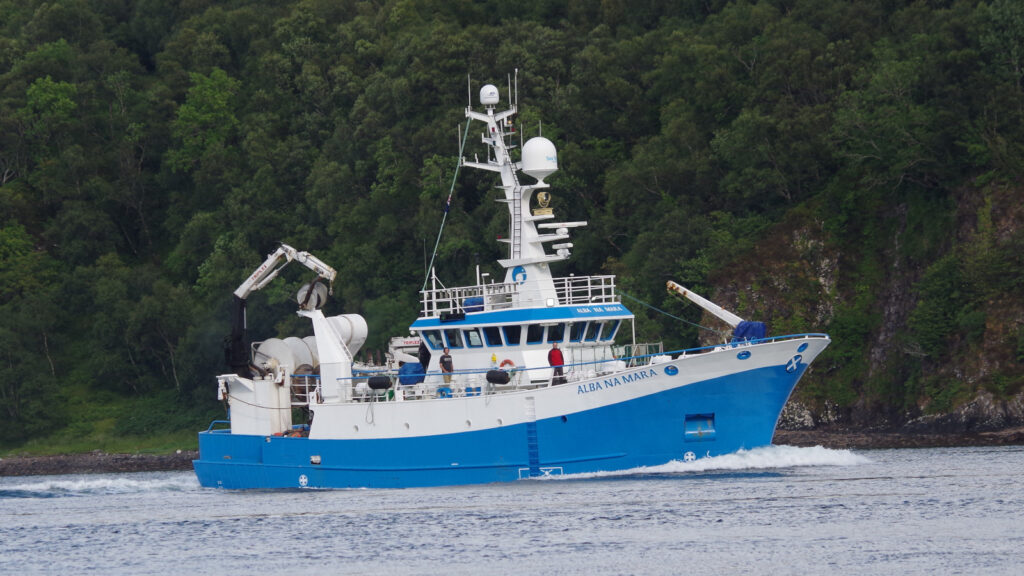
An underwater acoustic encounter with the Scottish research vessel Alba na Mara raises wider questions about scientific echosounders, recreational boats and repeated exposure to high-frequency sonar in Scotland’s coastal waters.
On 8 August 2021, Clyde Porpoise was conducting underwater acoustic surveys in Loch Alsh when we encountered Marine Scotland’s research vessel Alba na Mara.
Our towed hydrophone array recorded a series of distinctive high-frequency acoustic transmissions. Subsequent analysis identified repetitive signals centred around 38, 50 and approximately 120 kHz, consistent with scientific and navigational echosounders carried aboard the vessel.
The recordings provide an opportunity to examine a potentially overlooked source of underwater noise: the active sonar systems routinely used by research vessels, fishing boats and recreational craft.
These systems are valuable for navigation, fisheries research and seabed investigation. However, their widespread use raises an important conservation question.
What happens when marine mammals are repeatedly exposed to high-frequency sonar, particularly in narrow and heavily trafficked coastal waters?
What is an echosounder?
An echosounder is a form of active sonar. It transmits a short pulse of sound into the water and measures the returning echoes to calculate depth, locate fish or examine underwater features.
Unlike a passive hydrophone, which listens to the underwater environment, an active echosounder introduces acoustic energy into it.
Many modern leisure boats carry fishfinders operating around 50, 83 or 200 kHz, while some newer systems use broader frequency bands and scanning sonars.
Scientific echosounders can be considerably more powerful and are designed to provide calibrated measurements of fish and other underwater targets.
Alba na Mara carries Simrad EK60 scientific echosounders operating at 38, 120 and 200 kHz, alongside a Simrad ES60 navigation echosounder operating at 50/200 kHz.
During our encounter, the 38 and 120 kHz signals repeated approximately once per second. The 50 kHz signals repeated around 3.6 times per second.
What did our hydrophones measure?
We subsequently re-examined the original four-channel WAV recordings using the hydrophones’ frequency-dependent calibration curves.
On hydrophone H3, the median received sound-pressure levels measured over the leading one millisecond of the transmissions were approximately:
| Frequency | Received sound-pressure level |
|---|---|
| 38 kHz | 165.5 dB re 1 µPa RMS |
| 121 kHz | 154.0 dB re 1 µPa RMS |
These are provisional received levels at the hydrophone, not the transmitted source levels of the equipment.
The two hydrophones showed a larger disagreement at 38 kHz than at 121 kHz, so further calibration checks are necessary. We have used the lower H3 measurement here as an illustrative result, rather than treating it as a fully validated absolute level.
The initial acoustic arrivals lasted roughly one millisecond, followed by longer decaying signals that may include reflections and reverberation.
The recordings demonstrate that substantial high-frequency acoustic energy can be detected outside the immediate downward-facing sonar beam.
They do not establish that a porpoise was present or disturbed during the encounter.
The narrow channel problem
Scientific echosounders generally concentrate their strongest acoustic output into a downward-pointing beam.
The 38 and 120 kHz transducers documented for Alba na Mara have main beams approximately seven degrees wide.
In an illustrative channel 50 metres deep, a downward-facing transducer situated 5.6 metres below the surface would produce a main-beam seabed footprint approximately 5.4 metres wide.
As a vessel travels through the channel, successive pulses illuminate overlapping sections of the seabed.
However, that narrow beam is not the limit of the acoustic footprint.
Sound is also transmitted through weaker sidelobes, while reflections from the seabed, surface and underwater slopes can introduce additional propagation paths.
A porpoise outside the central beam might therefore still receive sound from the vessel, although potentially at a substantially reduced level.
The actual exposed area depends on acoustic frequency, transmission power, beam direction, water depth, seabed characteristics and sound absorption.
It would be misleading to suggest that an echosounder necessarily exposes an entire sea channel to its full acoustic output. Equally, the narrow main beam should not be mistaken for a boundary beyond which the sound disappears.
New evidence that scientific echosounders can disturb porpoises
A particularly important study was published by Hubert and colleagues in Environmental Pollution in February 2026.
The researchers examined harbour porpoise acoustic occurrence during scientific echosounder operation at 13 monitoring deployments in the southern North Sea.
The echosounders operated at 70 kHz and 185–255 kHz, transmitting for approximately ten minutes every hour.
Across the study sites, recorded porpoise acoustic detections declined by 65–79% during echosounder operation.
Detections generally recovered towards normal levels within approximately 30 minutes of transmissions stopping.
Importantly, the researchers found no evidence that the response diminished over six weeks of repeated exposures.
The findings are consistent with temporary local displacement or changes in acoustic activity. A reduction in detections is not, by itself, proof that the same percentage of animals physically left the area.
Nevertheless, the research demonstrates that scientific echosounder operation can influence measures of harbour porpoise occurrence.
The authors also highlight the potential cumulative implications of high-frequency sonar used across offshore activities.
What do we know about recreational fishfinders?
The evidence is more mixed.
Dyndo and colleagues (2015) investigated harbour porpoise responses to passing vessels, including small recreational boats.
Of 80 usable vessel recordings, 31 included an operating 200 kHz echosounder.
The researchers measured cumulative sound exposure from those transmissions, but found no statistically significant relationship between the echosounder signals and the observed behavioural responses.
Instead, responses were associated with higher-frequency components of general vessel noise.
This provides an important caution: we should not assume that every operating fishfinder necessarily causes measurable behavioural disturbance.
The findings also emphasise the importance of distinguishing sonar emissions from broadband noise generated by propulsion, cavitation and machinery.
Different equipment, frequencies and exposure conditions may produce different biological effects.
Recreational boats can disturb porpoises even without sonar
A separate study by Hao and colleagues (2024) used drone footage to examine harbour porpoise responses to recreational motorboats travelling at 10 and 20 knots.
The researchers observed changes in swimming speed and movements away from the boats’ paths.
Notably, the experimental boat’s echosounder was deliberately switched off.
The study therefore demonstrated behavioural responses to recreational vessel approaches without simultaneously exposing the animals to active fishfinder transmissions.
This raises another question: when vessels operate with both propulsion machinery and echosounders transmitting, how do the different acoustic components contribute to the overall disturbance?
For many coastal encounters, that distinction has not been adequately investigated.
Cumulative disturbance: more than adding up decibels
Cumulative underwater sound exposure is often expressed using sound exposure level (SEL), which integrates acoustic energy over time.
Repeated pulses can increase cumulative SEL even when each individual transmission is brief.
However, an animal does not necessarily receive every pulse at the same level. A moving vessel creates rapidly changing source-receiver distances and beam angles.
A more complicated issue is the cumulative effect of repeated behavioural disturbance.
Imagine a harbour porpoise feeding in a narrow channel during a busy summer day.
It encounters a fishing boat, several recreational craft and perhaps a research vessel. Each may generate propulsion noise, while some also operate active echosounders.
A single disturbance might be brief. But repeated interruptions could reduce opportunities for uninterrupted foraging or encourage animals to avoid otherwise suitable habitat.
Wiśniewska and colleagues (2018) used acoustic tags to investigate vessel-noise exposure in wild harbour porpoises. They documented substantial exposure to vessel noise and associated interruptions to foraging behaviour.
This is important because harbour porpoises have high energetic demands and rely on frequent feeding.
Nevertheless, repeated behavioural responses do not automatically demonstrate a long-term population impact. That requires further evidence concerning recovery, prey availability, energetic costs and habitat use.
Could high-frequency sound interfere with echolocation?
Another concern is acoustic masking.
Harbour porpoises use narrowband high-frequency clicks, commonly centred around 130 kHz, to investigate their surroundings and locate prey.
Beedholm and colleagues (2025) demonstrated that experimentally presented noise centred around 125 kHz could interfere with harbour porpoise hearing during exposure.
The same experiment did not demonstrate temporary hearing-threshold shifts after the tested exposures.
This illustrates an important distinction: sound may interfere with hearing or behaviour without causing hearing injury.
The experiment used noise exposures rather than the particular short echosounder pulses recorded from Alba na Mara, so its results cannot be transferred directly to our encounter.
Nevertheless, acoustic interference is an additional issue deserving investigation.
What does this mean for Scotland’s coastal waters?
Scotland’s sea lochs, sounds and narrow channels often bring marine wildlife into close proximity with vessels.
Many such areas support harbour porpoises, dolphins, seals and other marine wildlife while also accommodating fisheries, aquaculture, commercial traffic, recreational boating and scientific research.
The combined underwater acoustic footprint of these activities remains incompletely understood.
In particular, relatively little research directly quantifies the long-term effects of high-frequency fishfinder exposure from multiple recreational vessels.
There are several practical questions worth investigating:
- How frequently are scientific and recreational echosounders transmitting in important porpoise habitat?
- What acoustic levels reach animals outside the main sonar beam?
- How do multiple vessel passages contribute to repeated exposure and interruptions to feeding?
- Could high-frequency sonar affect passive acoustic monitoring and the interpretation of porpoise detections?
- Can unnecessary acoustic transmissions be reduced without compromising safe navigation or essential scientific work?
These are questions about proportionality and good environmental practice, not arguments against marine research or the use of necessary navigation equipment.
Research equipment should be part of the environmental assessment
Scientific vessels make an essential contribution to marine conservation.
However, scientific purpose does not automatically mean negligible acoustic impact.
Where equipment transmits underwater sound, it is reasonable to understand the likely exposure of sensitive species and to minimise unnecessary emissions where practicable.
For Alba na Mara, we have demonstrated that multiple high-frequency echosounder-like transmissions occurred during the August 2021 encounter.
We have not established whether any of those transmissions were unnecessary, whether they breached an operating procedure or whether marine mammals were disturbed.
The value of the encounter lies in its ability to provide a real acoustic example against which manufacturer specifications, propagation models and published biological research can be considered.
Listening to the bigger picture
The latest research suggests that high-frequency sonar deserves greater attention in assessments of underwater noise.
Some scientific echosounders have been associated with reduced porpoise acoustic detections, while other studies have not established disturbance from particular recreational fishfinder transmissions.
Both findings matter.
Understanding cumulative effects will require measurements of real sound fields, vessel activity, animal behaviour and the duration of repeated exposures.
The conservation question is not whether every fishfinder is harmful. It is whether the combined use of active sonar across increasingly busy coastal waters creates an acoustic footprint that we have yet to measure adequately.
For harbour porpoises, and for the long-term management of Scotland’s inshore seas, that is a question worth investigating.
References and further reading
- Hubert, J. et al. (2026). Echosounders for fish detection disturb harbour porpoises. Environmental Pollution, 391, 127569.
- Dyndo, M. et al. (2015). Harbour porpoises react to low levels of high frequency vessel noise. Scientific Reports, 5, 11083.
- Hao, X. et al. (2024). Harbour porpoises respond to recreational boats by speeding up and moving away from the boat path. Ecology and Evolution, 14, e11433.
- Wiśniewska, D. M. et al. (2018). High rates of vessel noise disrupt foraging in wild harbour porpoises. Proceedings of the Royal Society B, 285, 20172314.
- Beedholm, K. et al. (2025). Moderate levels of high-frequency noise mask harbor porpoise hearing, but do not cause temporary threshold shift. Journal of the Acoustical Society of America, 158, 4212–4220.
- Scottish Government. MRV Alba na Mara — vessel and equipment specifications.
Technical note: The Clyde Porpoise sound-pressure measurements are provisional reconstructions from archived WAV recordings and graph-derived hydrophone calibrations. They have not been independently validated and should not be used as cetacean injury or disturbance thresholds.
Clyde Porpoise | October 2026