
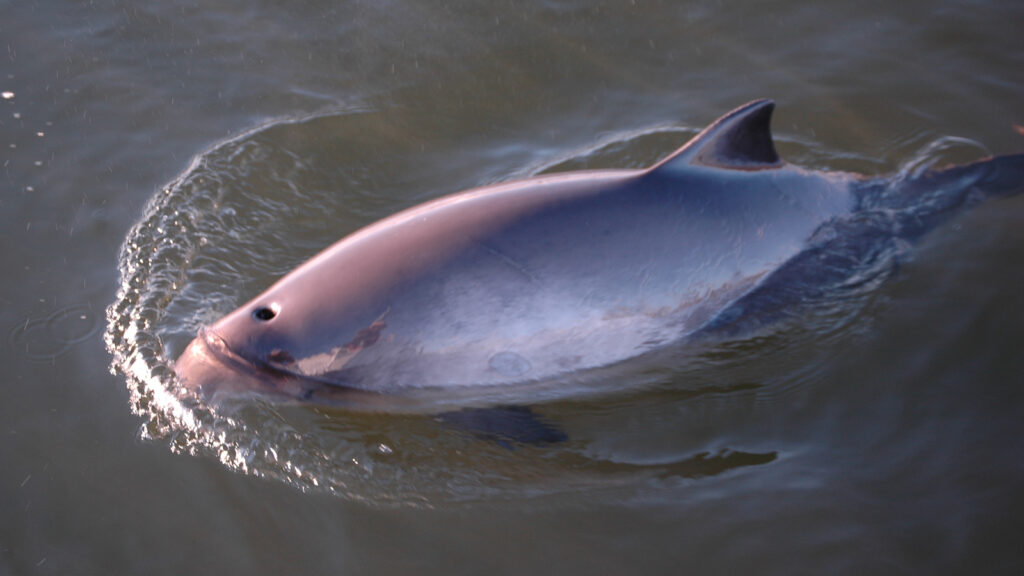
Wild dolphins sometimes appear to actively seek human contact. But does their willingness to interact mean that we should encourage it?
Few wildlife encounters are as captivating as a wild dolphin approaching a swimmer, paddleboarder or boat. Dolphins are intelligent, curious and highly social animals, and some individuals appear particularly interested in interacting with people.
For those fortunate enough to experience such encounters, the experience can be extraordinary. It can create a lasting emotional connection with the marine environment and inspire a genuine desire to protect it.
But there is a more difficult question worth asking: just because a dolphin appears to enjoy human company, does that mean encouraging the relationship is in its best interests?
A dolphin’s choice — or ours?
Dolphins occasionally approach people entirely of their own accord. They may investigate swimmers, repeatedly visit particular locations or remain close to boats.
It would be unreasonable to assume that every such encounter represents distress or disturbance. Curiosity and exploration are normal aspects of dolphin behaviour, and the animals themselves may initiate these interactions.
However, there is an important difference between allowing a wild animal to exercise its own curiosity and deliberately encouraging it to develop a relationship with humans.
A dolphin may choose to approach a person, but it cannot necessarily anticipate the longer-term consequences of becoming accustomed to people and boats.
What begins as an apparently harmless interaction may gradually change how the animal behaves around humans.
The hidden risks of becoming too friendly
Scientists have documented numerous cases of unusually sociable dolphins developing prolonged relationships with people.
A global review by Nunny and Simmonds (2019) highlighted serious concerns associated with these relationships, including injuries, harassment, inappropriate feeding, aggressive interactions and the deaths of some individual dolphins.
One of the principal concerns is habituation — the process through which an animal becomes increasingly accustomed to human presence and may lose some of its natural caution.
A dolphin that repeatedly experiences apparently positive interactions with swimmers may subsequently approach motorboats, fishing vessels or people who do not understand how to behave responsibly.
Research involving dolphins conditioned to accept food from people has demonstrated particularly serious consequences, including increased risks of injury and disruption to natural foraging behaviour.
Although feeding dolphins presents additional risks, repeated non-feeding interactions can also raise concerns about habituation and changes in behaviour.
The consequences may extend beyond the individual animal, particularly where mothers and calves are involved.
What about the dolphin’s social life?
Dolphins live in complex social environments. Their relationships with other dolphins can influence feeding, reproduction, learning and survival.
Occasionally, an individual dolphin may spend prolonged periods away from others of its own species and seek interactions with humans.
These animals are sometimes described as solitary-sociable dolphins.
It can be tempting to interpret their behaviour in human terms: perhaps the dolphin is lonely, needs companionship or has developed a friendship with a particular person.
But we should be cautious about assigning human emotions or motivations to behaviour we do not fully understand.
A dolphin approaching people does not necessarily mean it lacks opportunities for natural social interaction, nor that human companionship is beneficial to its welfare.
Indeed, research in the Clyde has documented the remarkable case of Kylie, a solitary common dolphin that developed acoustic interactions with harbour porpoises.
Such observations remind us that the social lives of dolphins may be considerably more complicated than appearances suggest.
Is it ever right to interact?
There is an important moral argument in favour of respecting a dolphin’s freedom to make its own choices.
If an animal voluntarily approaches a person, without being pursued, attracted or encouraged, should the interaction automatically be regarded as harmful?
Not necessarily.
However, the ethical responsibility lies primarily with the human participant, who may be better placed to understand the potential long-term risks.
A chance encounter and a deliberately cultivated relationship are not the same thing.
Entering the water specifically to attract a dolphin, repeatedly encouraging contact, touching it or attempting to maintain its attention moves the interaction away from passive wildlife observation.
At that point, the enjoyment of the human participant may begin to take precedence over the interests of the animal.
The fact that a dolphin appears willing to participate does not, by itself, demonstrate that an interaction is harmless.
Why this matters in the Clyde
The Firth of Clyde provides important habitat for bottlenose dolphins, common dolphins and harbour porpoises.
These animals already share their environment with commercial shipping, recreational boating, fishing and other human activities.
Encouraging dolphins to seek increasingly close relationships with people could introduce additional risks into an already busy marine environment.
Under Scottish legislation, dolphins and porpoises are European Protected Species, and deliberate or reckless disturbance or harassment can constitute an offence.
The Scottish Marine Wildlife Watching Code encourages people to observe marine wildlife responsibly, without approaching, pursuing or otherwise interfering with animals.
Importantly, an encounter initiated by a dolphin does not automatically mean that an offence has occurred. The circumstances, human behaviour and potential effects on the animal must all be considered.
Appreciating dolphins without changing their behaviour
There is no need to discourage people’s fascination with dolphins. That fascination can be a powerful force for conservation.
The Clyde offers excellent opportunities to observe cetaceans from the shoreline, allowing people to experience these animals without adding another vessel to their environment.
Where encounters occur at sea, the emphasis should be on passive observation, maintaining appropriate separation and allowing dolphins to continue their natural activities.
We should avoid pursuing, feeding, touching or deliberately encouraging close interactions, even where the animals appear playful or curious.
Perhaps the most important principle is to recognise that a wild dolphin’s freedom to approach people does not give people an automatic right to encourage, prolong or exploit that encounter.
Putting the dolphin first
The ethical issue is not whether dolphins and humans can enjoy encounters with one another. They may well do so.
The more important question is whether encouraging those interactions serves the long-term interests of the dolphin.
A relationship that brings immediate enjoyment to a person may expose the animal to risks that only become apparent over time.
Respecting wild dolphins means accepting that their lives, relationships and behaviour should remain largely independent of our desire to interact with them.
Perhaps the greatest expression of our affection for wild dolphins is not persuading them to become our friends, but ensuring they remain free to live as wild dolphins.
Further reading
Nunny, L. & Simmonds, M. P. (2019). A Global Reassessment of Solitary-Sociable Dolphins. Frontiers in Veterinary Science.
Pirotta, E. et al. (2015). Quantifying the effect of boat disturbance on bottlenose dolphin foraging activity. Biological Conservation, 181, 82–89.
Moreno, K. R. & Macgregor, R. P. (2019). Bubble Trails, Bursts, Rings, and More: A Review of Multiple Bubble Types Produced by Cetaceans. Animal Behavior and Cognition.
NatureScot. Scottish Marine Wildlife Watching Code.