
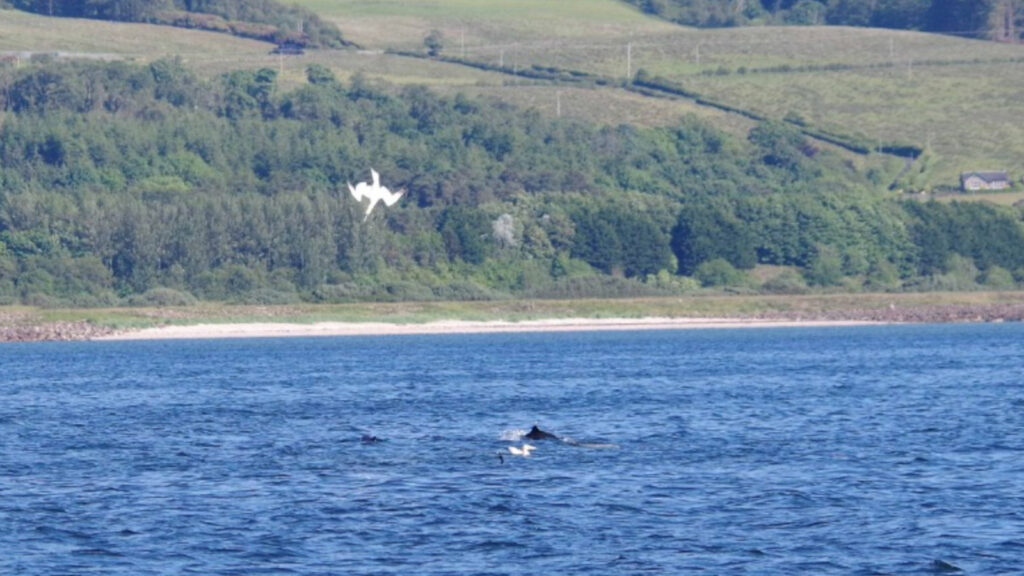
Understanding one of the Clyde’s most elusive marine mammals could help us build a clearer picture of the health of the entire marine ecosystem.
Harbour porpoises (Phocoena phocoena) are much more than an interesting part of the Clyde’s wildlife. As predators feeding on fish throughout the marine food web, they can provide valuable clues about the condition of the waters they inhabit.
Scientists often describe such animals as indicator or sentinel species. By studying their distribution, feeding behaviour, health and population trends, we may detect changes taking place within the wider ecosystem that would otherwise be difficult to recognise.
What can porpoises tell us?
Porpoises depend on a regular supply of suitable prey. Changes in where they feed, how frequently they occur and their seasonal movements may therefore reflect changes in fish populations and the availability of productive feeding habitats.
Their health can also reveal less visible environmental problems. As predators, porpoises can accumulate persistent pollutants through their food. Studies of stranded UK harbour porpoises have identified associations between PCB contamination and reproductive problems, demonstrating how pollutants can affect marine mammals long after their original release.
Porpoises are also particularly sensitive to underwater sound. Shipping, construction, sonar and acoustic deterrent devices can alter their acoustic environment, potentially interfering with feeding, communication and habitat use.
Why is this important for the Clyde?
The Clyde is a complex marine ecosystem shaped by fishing, shipping, aquaculture, coastal development and a long history of industrial activity.
Through Clyde Porpoise’s long-term acoustic surveys, we are building a better understanding of where porpoises occur, which areas they use regularly and how their distribution may change over time.
By combining acoustic monitoring with information on fish populations, underwater noise, pollution and the health of stranded animals, we can begin to identify relationships between porpoise behaviour and wider environmental conditions.
However, simply finding porpoises does not prove that an ecosystem is healthy. Animals may continue to occupy habitats where they face substantial environmental pressures. Equally, changes in their distribution can have several possible explanations.
The real value lies in monitoring changes over time and understanding what is driving them.
Looking at the bigger picture
Protecting harbour porpoises is important in its own right, but understanding their ecology offers something more: an opportunity to assess how the Clyde’s marine environment is functioning.
As our knowledge improves, porpoises may help us identify important feeding habitats, recognise emerging environmental pressures and assess whether conservation measures are making a difference.
Ultimately, understanding the health of the Clyde’s porpoises could help us better understand the health of the Clyde itself.
Further reading
- Bossart, G.D. (2011). Marine Mammals as Sentinel Species for Oceans and Human Health. Veterinary Pathology, 48(3), 676–690. Read article
- OSPAR Commission (2023). Marine Mammals Thematic Assessment. Quality Status Report 2023. Read assessment
- Murphy, S. et al. (2015). Reproductive Failure in UK Harbour Porpoises: Legacy of Pollutant Exposure? PLOS ONE, 10(7), e0131085. Open-access paper
- Lennon et al. (2025). The Dead Do Tell Tales: Using Pathology Data From Cetacean Necropsy Reports to Gain Insights Into Animal Health. Ecology and Evolution. Open-access paper
- Marine Scotland (2012). Clyde Ecosystem Review. Scottish Marine and Freshwater Science, Volume 3, Number 3. Read report