
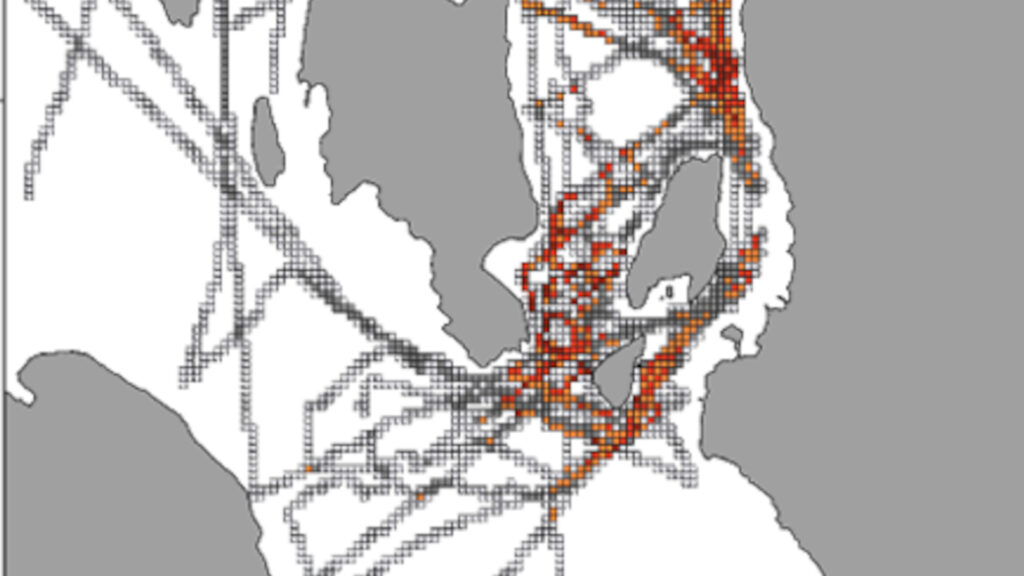
Exploratory research using acoustic surveys, habitat modelling and spatial analysis reveals a complex pattern of harbour porpoise activity in the northern Firth of Clyde.
Harbour porpoises are widespread around Scotland’s coastline, but their distribution is far from uniform. Even within a relatively small area of sea, some locations may be used more frequently than others.
Understanding where these areas occur, why porpoises use them and how their distribution changes over time is important for effective conservation.
In 2018, William Brown completed an MSc dissertation at the University of St Andrews entitled Fine scale distribution and habitat use of harbour porpoises (Phocoena phocoena) in the Firth of Clyde, supervised by Dr Jonathan Gordon and Dr Simon Northridge.
Using acoustic survey data collected by Clyde Porpoise CIC, Brown investigated whether harbour porpoises were distributed evenly across the northern Clyde or whether particular locations supported consistently higher levels of activity.
His findings suggested something more interesting than a single extensive hotspot: a mosaic of smaller areas of higher porpoise use within a varied coastal environment.
Exploring the Clyde at a finer scale
Large-scale cetacean surveys are valuable for estimating abundance and identifying broad patterns of distribution. However, they may overlook smaller concentrations of animals associated with particular coastal features.
Brown’s research concentrated on a repeatedly surveyed area in the northern Firth of Clyde, particularly around the Cumbrae Islands and adjacent waters.
The study analysed 25 passive acoustic monitoring surveys conducted between October 2016 and November 2017.
The surveys used a towed hydrophone array and PAMGuard software to detect the high-frequency echolocation clicks produced by harbour porpoises.
Across the surveys, Brown identified 621 acoustic events classified as certain or likely porpoise detections. Of these, 319 were localised porpoise-certain click trains.
These events were evidence of porpoise activity rather than a count of individual animals. Nevertheless, they provided a valuable dataset for investigating where porpoises were encountered and how those encounters related to their surroundings.
By dividing survey tracks into 250-metre sections, Brown was able to investigate patterns at a much finer spatial scale than those normally resolved by broad regional surveys.
Three approaches to understanding porpoise distribution
One of the strengths of the research was its use of three complementary analytical approaches.
Habitat modelling examined relationships between porpoise detections and environmental variables, including water depth, seabed slope, tides and proximity to features such as navigation buoys and sewage outfalls.
Hotspot analysis identified areas where relatively high levels of porpoise detection occurred across repeatedly surveyed locations, taking account of neighbouring grid cells and differences in survey coverage.
Cluster analysis explored whether detections from different surveys were found closer together than expected from the distribution of surveyed locations.
Together, these approaches allowed Brown to investigate not only where porpoises were detected, but also which environmental characteristics might help explain their distribution.
A mosaic of preferred areas
Perhaps the most striking finding was the identification of several relatively small areas of higher porpoise detection rather than one continuous, uniformly occupied region.
Hotspot analysis was particularly informative when applied to a 250-metre grid. Analyses using larger 500-metre and 1,000-metre grids produced less clearly defined hotspots.
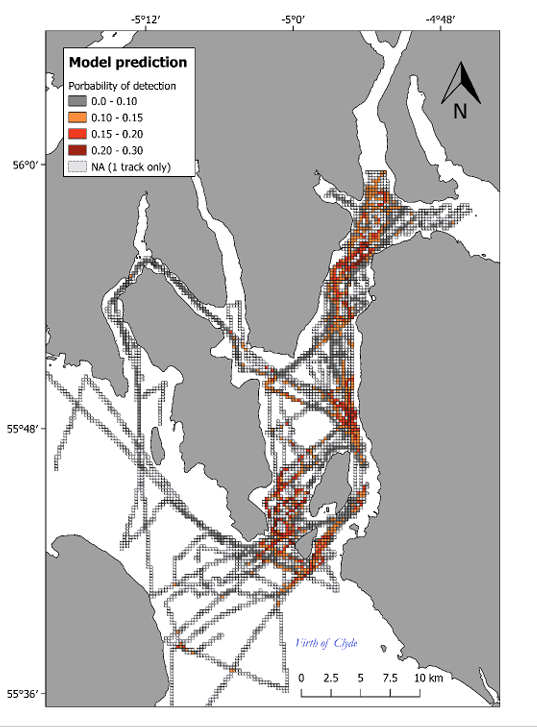
Areas of higher use were identified to the east and west of Little Cumbrae, north of Great Cumbrae, in the northern part of the focal survey area and at several smaller locations around the Isle of Bute.
The habitat model and hotspot analysis identified broadly similar geographical patterns, providing complementary evidence that the distribution was spatially structured.
Rather than regarding the northern Clyde as one large area of broadly similar habitat, the findings suggested a patchwork of locations with differing levels of porpoise activity.
This distinction matters because small, highly used areas could be overlooked when surveying or managing the marine environment at much coarser scales.
What did the cluster analysis reveal?
Brown also explored the spacing between acoustic detections recorded on different survey tracks.
The analysis suggested that detections were somewhat more concentrated at distances below approximately 2 kilometres than expected from the comparison distribution of surveyed locations.
This was consistent with the fine-scale patterns suggested by the hotspot maps, although the statistical interpretation of the clustering result requires further examination.
The findings should not be interpreted as evidence that porpoises were gathering into social groups or that particular individual animals repeatedly returned to the same places.
The analysis concerned the geographical clustering of acoustic detections, rather than the social behaviour or identity of individual porpoises.
Together with the mapped hotspots, it raised an important ecological possibility: harbour porpoises may use a network of relatively small, locally favourable areas within the wider Clyde.
Why might some areas be more attractive?
Brown’s habitat modelling identified water depth as an important predictor of porpoise detections.
Detection probability increased with depth to approximately 40 metres and remained relatively high across much of the deeper water surveyed, including depths approaching 150 metres.
The study also identified relationships involving seabed slope, tidal range, month and distances to navigation buoys and sewage outfalls.
These relationships offer clues about the processes potentially influencing porpoise distribution.
Steep seabed slopes and tidal movements can influence currents, mixing and the distribution of prey. Porpoises may therefore be responding to feeding opportunities associated with these features rather than to water depth or slope alone.
Brown also explored whether navigation buoys might provide shelter for small fish, potentially creating local feeding opportunities. An observed association with proximity to some sewage outfalls raised further questions about possible prey aggregation.
These were hypotheses, not demonstrated causal relationships. The research did not establish that buoys or outfalls attract porpoises, nor did it directly measure prey concentrations at these locations.
Nevertheless, these exploratory findings suggest that different hotspots may be associated with different combinations of environmental conditions, rather than all being explained by one simple habitat preference.
Why does this matter for conservation?
The possibility that harbour porpoises use a network of small, spatially distinct hotspots has several implications.
First, marine conservation cannot rely solely on broad-scale distribution maps. Such maps may identify important regions while overlooking smaller areas that contribute disproportionately to local habitat use.
Second, the positioning of stationary acoustic monitoring devices becomes particularly important. A detector placed within a hotspot may record much higher activity than one positioned a short distance away. Without understanding that spatial variation, monitoring results may not accurately represent the wider area.
Brown recommended that fine-scale surveys should inform the placement of static acoustic monitoring devices, or that sufficiently extensive monitoring networks should be used to capture spatial differences.
Third, understanding these patterns may help identify where harbour porpoises encounter human activities.
The Firth of Clyde supports shipping, fishing, aquaculture, coastal infrastructure and other marine uses. Some of these activities create underwater noise, disturb marine mammals or alter habitats and prey availability.
A network of small, frequently used habitat patches may overlap with several different pressures, potentially requiring conservation measures that look beyond individual development sites or protected-area boundaries.
The thesis did not directly measure these pressures at individual hotspots, but it provided a basis for investigating them.
Building on the research
One of the most valuable contributions of Brown’s dissertation was demonstrating that repeated vessel-based acoustic surveys could reveal spatial patterns that might otherwise remain hidden.
The study provided an early analytical foundation for exploring fine-scale harbour porpoise habitat use in the Clyde.
It was exploratory, and the habitat model did not fully explain the observed patterns. Acoustic detection probability, uneven seasonal survey coverage and uncertainty over the localisation of some detections also limit interpretation.
Consequently, the hotspot maps should be understood as patterns of relatively high recorded acoustic activity, not direct estimates of absolute porpoise density.
Future research can build on this work by increasing temporal coverage, refining acoustic localisation, improving survey-effort and detection corrections, investigating prey availability and examining whether the same hotspots persist across multiple years.
Ultimately, the conservation significance of a hotspot depends not simply on how often porpoises are detected there, but on the ecological functions that location may provide.
These could include feeding opportunities, movement corridors or other forms of important habitat use.
Looking beneath the surface
Brown’s 2018 research offered an important early insight into the fine-scale distribution of harbour porpoises in the Firth of Clyde.
The emerging picture was not of animals spread uniformly throughout the survey area, but of a more intricate pattern of higher-use locations associated with a complex coastal environment.
This mosaic of acoustic hotspots may be an important part of understanding how harbour porpoises use the Clyde.
For conservation, the message is that recognising the Clyde as porpoise habitat is only the beginning. We also need to understand which parts are used most frequently, why they are important and how human activities may affect them.
By building on exploratory studies such as Brown’s, more detailed and evidence-led approaches to harbour porpoise conservation can be developed.
Research reference
Brown, W. (2018). Fine scale distribution and habitat use of harbour porpoises (Phocoena phocoena) in the Firth of Clyde. MSc Marine Mammal Science dissertation, University of St Andrews. Supervised by Dr Jonathan Gordon and Dr Simon Northridge.
Based on 2016–2017 acoustic survey data collected by Clyde Porpoise CIC.