
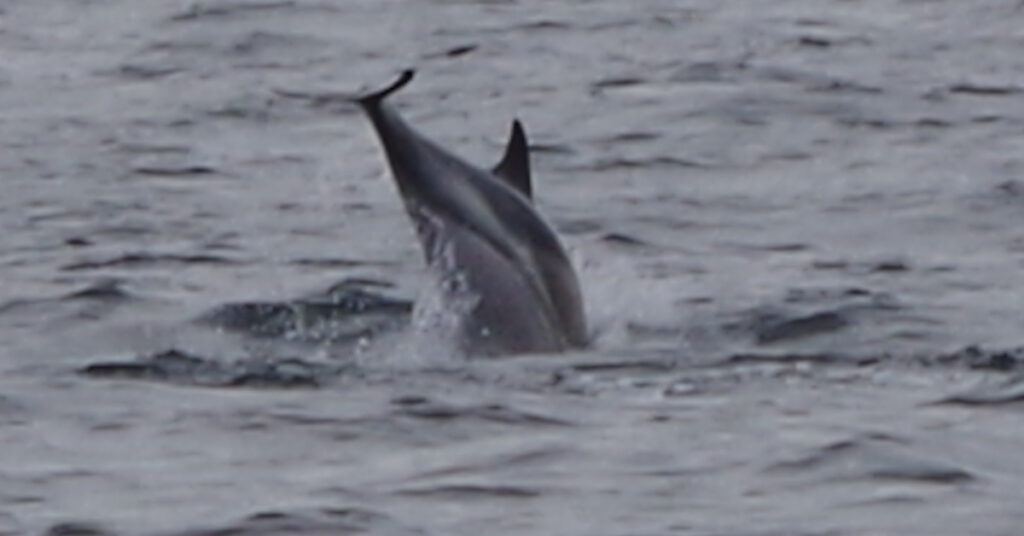
An underwater acoustic encounter recorded by Clyde Porpoise on 2 August 2021
Dolphins inhabit an extraordinary world of sound. Using sophisticated echolocation, they can investigate their surroundings, locate prey and navigate through underwater environments where visibility may be extremely limited. But what do these remarkable sounds look and sound like when captured by underwater hydrophones?
During a Clyde Porpoise acoustic survey on a transect from Tobermory to Barra 2, three short-beaked common dolphins (Delphinus delphis) were observed at the surface, at least 200 metres from our vessel. There may have been additional animals beneath the surface.
The encounter was recorded using our four-channel towed hydrophone array, sampling at 500,000 times per second.
Our vessel’s echosounder was switched off throughout the recording.
The recording contains broadband acoustic clicks and extraordinary sequences of rapidly repeated pulses, some occurring more than 600 times per second.
We have produced an audiovisual presentation of the recording, slowed to half its original speed, with a moving playhead tracking the sounds through a synchronised waveform and FFT spectrogram.
The result offers a fascinating glimpse into the acoustic environment occupied by common dolphins.
How dolphins use echolocation
Common dolphins belong to the toothed whales, or odontocetes, a group of marine mammals that have evolved highly sophisticated biological sonar.
They produce brief, high-frequency clicks that travel through the water and reflect from surrounding objects.
By interpreting the returning echoes, dolphins can obtain information about the location, movement and characteristics of objects, including potential prey.
Dolphin echolocation clicks are usually extremely short, often lasting only a few tens of microseconds.
These brief pulses contain acoustic energy across a broad range of frequencies, much of it ultrasonic and therefore beyond normal human hearing.
When searching for prey, a dolphin may produce relatively widely separated echolocation clicks.
As it approaches a target, the intervals between clicks can become progressively shorter, sometimes developing into an extremely rapid sequence known as a terminal buzz.
However, dolphins also produce other rapidly repeated sounds, commonly described as burst pulses, which may be associated with social communication.
Distinguishing these different acoustic behaviours requires careful analysis.
What did our hydrophones record?
The original recording lasts 54.96 seconds and contains four simultaneous hydrophone channels, sampled at 500 kHz.
Our preliminary analysis identified two particularly interesting acoustic patterns.
Individual broadband clicks
In several sections, the recording contains brief, relatively isolated acoustic pulses.
These appear as sharp spikes in the waveform and near-vertical features on the spectrogram.
A selected group of pulses had approximate half-amplitude envelope widths of 76–80 microseconds, with broadband acoustic energy extending above 100 kHz.
These characteristics are consistent with the general properties of common-dolphin echolocation clicks reported in published research.
Such sounds can provide information about underwater objects and potential prey, although we cannot determine the purpose of an individual click from its waveform alone.
Rapid click trains and buzz-like sounds
Other sections contain something quite different.
Individual pulses become much more closely spaced, forming rapid, rhythmic sequences.
In selected passages, we measured repetition rates of approximately 530–670 pulses per second.
For example:
| Original recording time | Approximate pulse rate |
|---|---|
| 22.5 seconds | 606 pulses/s |
| 23.5 seconds | 645 pulses/s |
| 30.5 seconds | 667 pulses/s |
| 33.5 seconds | 571 pulses/s |
| 40 seconds | 541 pulses/s |
These rapid sequences contain a prominent spectral component around 30–32 kHz, although their energy also extends across other frequencies.
Such rapid repetition rates overlap those described for common-dolphin burst-pulsed vocalisations in the scientific literature.
They could potentially represent echolocation buzzes or social burst pulses.
However, some sequences display unusually consistent pulse intervals and waveform shapes. Although our vessel’s echosounder was switched off, we have not yet excluded every possible external acoustic source.
We therefore describe these particular signals as buzz-like or burst-pulsed sounds, pending further source verification.
Watch and listen: the complete recording at half speed
To make the acoustic patterns easier to follow, we have produced a new video presentation of the complete encounter.
The original 55-second recording has been slowed to 50% of its original playback speed, giving a presentation lasting approximately 1 minute and 50 seconds.
Unlike our earlier demonstration, which used electronic frequency translation to make ultrasound audible without changing the duration, the new version plays back the recorded waveform at half speed.
This lowers the pitch by one octave while preserving the relative timing and rhythm of the recorded pulses.
We have removed the previous heterodyne frequency-translation effect, producing a less electronically processed listening experience.
Some of the higher-frequency dolphin sounds remain beyond human hearing even at half speed. The accompanying spectrogram therefore reveals acoustic information that cannot necessarily be heard in the soundtrack.
How to interpret the video
The video contains two synchronised graphical displays.
Upper panel — Waveform
The waveform shows changes in the recorded sound pressure signal over time.
Individual clicks appear as short, sharp pulses, while rapid sequences form dense patterns of closely spaced spikes.
Lower panel — FFT spectrogram
The Fast Fourier Transform (FFT) spectrogram shows how acoustic energy is distributed across frequency and time.
Short broadband clicks produce nearly vertical features, while repeated pulses form closely spaced patterns.
The spectrogram uses the original recording’s frequency scale rather than the lower frequencies produced during slowed playback.
A moving cyan playhead tracks the waveform and spectrogram in synchronisation with the soundtrack.
The analysis uses hydrophone H2, corresponding to channel 3 in Audacity.
What to look and listen for
The most interesting sections occur between approximately 40 and 80 seconds of the slowed video, corresponding to 20–40 seconds in the original recording.
During these passages, the rapidly repeated pulses become particularly prominent.
Watch the spacing between the pulses in the upper waveform panel and compare it with their appearance on the spectrogram below.
Slowing the recording allows the pulse patterns to be examined more easily, although their biological interpretation remains subject to further investigation.
How do these sounds compare with published common-dolphin recordings?
The acoustic behaviour of short-beaked common dolphins has been investigated in several scientific studies.
Vella and colleagues (2021) reviewed published information about common-dolphin acoustic behaviour, including echolocation clicks, whistles and burst-pulsed sounds.
Our measured click durations and ultrasonic frequency content overlap the characteristics described in that literature.
More recently, Pagliani and colleagues (2024) examined the time-frequency characteristics of pulsed sounds produced by common dolphins.
Their work highlights the importance of pulse repetition rate, duration and frequency structure when distinguishing different categories of sound.
The rapid pulse sequences in our recording overlap the temporal characteristics reported for burst-pulsed vocalisations.
An especially valuable reference was published by Lehnhoff and colleagues in 2025.
Their open-access dataset contains high-resolution recordings of wild short-beaked common dolphins from the Bay of Biscay, including recordings associated with observed animal behaviour.
Such datasets provide an important opportunity to compare recordings from Scottish waters with independently documented acoustic repertoires.
Nevertheless, overlapping acoustic characteristics alone cannot establish that every sound in our recording originated from the visually identified dolphins.
Can the recording tell us whether the dolphins were feeding?
One of the most interesting questions concerns the rapid buzz-like sequences.
Dolphins may substantially increase their click repetition rates when approaching prey, producing fast acoustic buzzes during the final stages of a pursuit.
However, rapid pulsed sounds can also occur during social interactions between dolphins.
Our surface observations confirmed the presence of three common dolphins, with the possibility of additional animals underwater.
The dolphins were not bow-riding and were at least 200 metres from our vessel.
We do not have sufficient behavioural evidence to establish whether the animals were feeding, socialising or engaged in another activity.
The recording therefore provides an opportunity to investigate these possibilities rather than demonstrating a particular behaviour conclusively.
Further examination of pulse timing, frequency structure and acoustic bearings may help distinguish the recorded signal types.
What about whistles?
Common dolphins produce frequency-modulated whistles as well as echolocation clicks and burst-pulsed sounds.
Whistles commonly appear on a spectrogram as curved, continuous traces, quite different from the short vertical features produced by broadband clicks.
In the sections examined so far, we have not confidently isolated individual whistles suitable for detailed classification.
Further analysis may reveal whistles that are weaker or masked by the more intense pulsed sounds.
Why are recordings like this important?
Passive acoustic monitoring allows researchers to investigate the lives of marine mammals beyond the brief moments when they are visible at the surface.
Dolphins may spend substantial periods underwater, often beyond the range of visual observation.
High-frequency hydrophone recordings can reveal acoustic activity associated with echolocation, communication and potential feeding behaviour.
Combining acoustic recordings with visual sightings strengthens our understanding of which species are present, while also highlighting the difficulty of linking individual sounds to particular animals.
This information is valuable for marine conservation.
As underwater habitats experience increasing noise from shipping, aquaculture, construction and other human activities, understanding the natural acoustic environment becomes increasingly important.
For Clyde Porpoise, the August 2021 encounter provides an opportunity to investigate common-dolphin acoustic behaviour using our existing research recordings.
It also demonstrates how visual observations, high-resolution acoustic measurements and accessible audiovisual presentations can contribute to public understanding of marine mammal science.
The sea is far from silent. Hidden beneath its surface is a complex world of sound — one that we are only beginning to understand.
References
- Vella et al. (2021). A review of the acoustic behaviour of the short-beaked common dolphin, Delphinus delphis. Aquatic Conservation: Marine and Freshwater Ecosystems. https://doi.org/10.1002/aqc.3538
- Pagliani et al. (2024). Sounds in common: Time-frequency as the classification parameters for pulsed sounds produced by Delphinus delphis. Behavioural Processes, 221, 105091. https://doi.org/10.1016/j.beproc.2024.105091
- Lehnhoff et al. (2025). High-resolution acoustic recordings of wild free-ranging short-beaked common dolphins for etho-acoustical and repertoire studies. Earth System Science Data, 17, 4495–4522. https://doi.org/10.5194/essd-17-4495-2025
Photograph and underwater recording: Clyde Porpoise, 2 August 2021. Acoustic analysis and audiovisual presentation: Clyde Porpoise, 2026.